Quick Answer
What Is AI Readiness for Leaders?
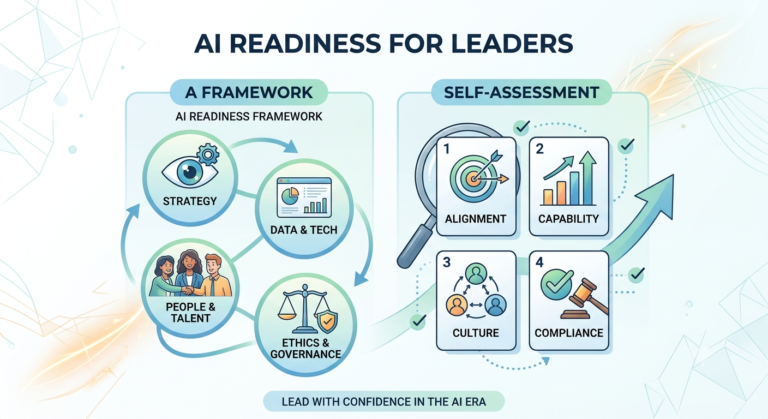
AI readiness for leaders is a leadership team's ability to set a clear AI direction, use AI confidently themselves, make sound decisions about where AI should and should not be used, set guardrails, bring people with them and turn pilots into results. Most AI readiness assessments measure data and technology. In practice, leadership readiness is usually the bottleneck, and it is the easiest pillar to fix quickly.
Fully AI-ready
13% of companies
CEOs owning AI
72%, double last year
The six dimensions
Direction to execution
Self-check
12 questions, 10 minutes
Ask most organisations whether they are ready for AI and they will talk about data quality, cloud infrastructure and security. Those matter. But the organisations that are pulling ahead with AI are not distinguished mainly by their technology. They are distinguished by leaders who have a clear direction, make decisions about AI with confidence, and lead their people through the change.
This guide explains what AI readiness means for leaders, what the data says about how ready organisations really are, the common pillars and stages of AI readiness, and a practical framework your leadership team can use. It ends with a 12-question self-assessment you can complete in ten minutes.
What Does AI Readiness Mean?
AI readiness is an organisation’s ability to adopt, deploy and scale AI responsibly and in a way that creates measurable value. It is usually assessed across strategy, data, technology, people, governance and culture.
It helps to separate two levels:
- Organisational AI readiness asks whether the foundations are in place: data, infrastructure, security, governance processes and skills.
- Leadership AI readiness asks whether the people at the top can use those foundations well: setting direction, prioritising, deciding, governing and leading change.
An organisation can have excellent data and still stall, because nobody at the top has decided which few AI priorities matter, who owns them, or how success will be measured. That is why leadership readiness deserves its own assessment.
How Ready Are Organisations for AI, Really?
Not very. Cisco’s 2025 AI Readiness Index, a survey of more than 8,000 AI leaders across 30 markets, found that only 13% of companies qualify as fully prepared “Pacesetters”. Those Pacesetters were three times more likely to move AI pilots into production and 72% more likely to report measurable value.
The pressure on leaders is rising fast. In BCG’s AI Radar 2026, a survey of 2,360 executives including 640 CEOs, 72% of CEOs said they are now directly responsible for AI decisions, twice the share of a year earlier, and about half believed their own job depends on getting AI right. And in Korn Ferry’s research, 42% of CHROs said they are prioritising AI investment, but only 5% said their teams are well prepared to embrace it.
13%
of companies are fully AI-ready (Cisco)
3×
more likely to move pilots into production when ready
72%
of CEOs now directly own AI decisions (BCG)
5%
of CHROs say their teams are well prepared (Korn Ferry)
The most revealing data is about what separates the ready from the rest. Cisco’s India findings show it clearly. India has a higher share of Pacesetters (17%) than the global average, but the gap between Pacesetters and other Indian companies sits largely in leadership disciplines: a roadmap, a change-management plan, finalised use cases and a process for scaling.
What AI-ready companies do differently
AI Pacesetters vs all companies, India
All Indian companies
Have an AI roadmap
99%
67%
Have a change-management plan
91%
45%
Have use cases finalised and ready to deploy
77%
24%
Have a mature process for scaling AI
62%
16%
Source: Cisco AI Readiness Index 2025, India findings, as reported by CRN Asia (October 2025).
A roadmap, a change plan and a short list of agreed use cases are not technology. They are leadership decisions, and they are where most organisations fall behind.
What Are the Pillars of AI Readiness?
There is no single official set. Different frameworks count three, five, six or seven pillars, but they cover much the same ground. The table compares two of the best-known free assessments with the simplified versions people often quote.
| Framework | Pillars |
|---|---|
| Microsoft AI Readiness Assessment (7) | Business strategy; AI governance and security; data foundations; AI strategy and experience; organisation and culture; infrastructure for AI; model management |
| Cisco AI Readiness Index (6) | Strategy; infrastructure; data; governance; talent; culture |
| Common five-pillar version | Strategy; data; technology; people and skills; governance and culture |
| Common three-pillar version | People; process; technology |
Notice what most of these frameworks share: they are organisational and largely technical. Leadership appears inside “strategy” or “culture” rather than as something to assess in its own right. That is the gap our framework below is designed to fill.
What Are the Five Stages of AI Readiness?
Maturity models describe how organisations progress. One widely cited version is Gartner’s five-level AI maturity model:
| Stage | What it looks like | The leadership question |
|---|---|---|
| 1. Awareness | AI is discussed, but there is no strategy or real use | Why does AI matter to us? |
| 2. Active | Informal experiments and pilots | Which experiments deserve investment? |
| 3. Operational | AI is part of day-to-day work in some areas | How do we scale and govern what works? |
| 4. Systemic | AI is used in new ways that change business models | How should our operating model change? |
| 5. Transformational | AI is pervasive and central to the value offered to customers | How do we stay ahead? |
Many organisations are at different stages in different functions. The leadership task is to move deliberately from stage two to stage three, which is where most AI efforts stall.
The Six Dimensions of AI Readiness for Leaders
We use six dimensions to assess leadership AI readiness in our programmes. Each reflects a decision or behaviour that the research links to AI success, and each can be developed.
| Dimension | What an AI-ready leader does | Warning sign |
|---|---|---|
| 1. Direction | Links AI to business goals and agrees a short list of priorities with owners | Every function runs its own AI agenda |
| 2. Fluency | Uses AI personally every week and understands what it can and cannot do | AI is “something the IT team handles” |
| 3. Judgement | Knows which decisions AI should automate, inform or stay out of, and when to verify | Either blind trust or blanket scepticism |
| 4. Guardrails | Sets clear rules on data, acceptable use and accountability | Staff use unapproved tools because no one has said what is allowed |
| 5. People | Addresses fears honestly, builds skills and redesigns roles with teams | AI is announced, not led |
| 6. Execution | Moves pilots into production and measures results against a baseline | Many pilots, no scaled results |
These dimensions sit comfortably alongside Korn Ferry’s description of the AI-ready leader, which emphasises sustaining a vision, taking decisive action, scaling for impact, championing learning and unlearning, and addressing fears. Our addition is to make them measurable, and to test every AI decision through the 10X Humane AI Lens: is the value real, is this the right use of AI, does it raise people up, and who remains responsible?
AI Readiness Self-Assessment for Leaders
Score each statement from 1 (not at all true) to 5 (completely true) for yourself or your leadership team. Be honest: the value is in the gaps, not the total.
| # | Statement | Dimension |
|---|---|---|
| 1 | Our leadership team has agreed two or three AI priorities linked to business goals. | Direction |
| 2 | Each AI priority has a named business owner, not just a technology owner. | Direction |
| 3 | I use AI tools in my own work at least weekly. | Fluency |
| 4 | I can explain what AI does well and badly in plain business language. | Fluency |
| 5 | We have agreed which decisions AI may automate and which must stay with people. | Judgement |
| 6 | I routinely check AI outputs before acting on them in important decisions. | Judgement |
| 7 | Our people know which AI tools are approved and what data they may use. | Guardrails |
| 8 | Accountability for AI-supported decisions is clear. | Guardrails |
| 9 | We have talked openly with our teams about how AI will change their roles. | People |
| 10 | Managers are equipped and expected to help their teams adopt AI. | People |
| 11 | At least one AI use case has moved from pilot into everyday work. | Execution |
| 12 | We measure AI results against a baseline, not just usage. | Execution |
How to read your score (12–60)
12–27: Awareness. AI is on the agenda but not yet in how you lead. Start with shared AI fluency for the leadership team and two or three agreed priorities.
28–44: Application. You are using AI and running pilots. The gaps are usually guardrails, people and scaling. Focus on decision rights, manager capability and moving one use case into production.
45–60: Amplification. AI is shaping strategy and operations. Keep raising the bar: redesign workflows, measure business outcomes and develop the next layer of leaders.
Also look at your lowest-scoring dimension. A strong total with one weak dimension, often Guardrails or People, is where AI programmes most often stall
Free tool
Get your organisation’s AI readiness score in 5 minutes
Answer 12 questions and see your score across all six dimensions, the two gaps to fix first and a 90-day plan. Free, and you can email yourself the full report.
Take the Assessment →How Do You Conduct an AI Readiness Assessment?
For a full organisational assessment, combine the technical and leadership views:
- Agree the purpose. Is the assessment to set strategy, prioritise investment, or prepare for a specific programme? The purpose shapes the questions.
- Assess the foundations. Use a structured tool, such as the free Microsoft or Cisco assessments, to review strategy, data, infrastructure, governance, talent and culture.
- Assess leadership readiness separately. Have each leader complete a self-assessment like the one above, then compare scores across the team. Differences in perception are often the most useful finding.
- Talk to people closest to the work. Short interviews or a pulse survey reveal actual AI use, unapproved tools and concerns that leaders may not see.
- Prioritise the gaps. Pick the two or three gaps that most block your AI priorities. Not every gap needs closing before you start.
- Turn findings into a plan. Owners, actions and dates for the next 90 days, with a reassessment to measure progress.
How to Build AI Readiness in Your Leadership Team in 90 Days
| Phase | Focus | Output |
|---|---|---|
| Days 1–30 | Shared AI fluency and hands-on use for the leadership team; baseline assessment | Common language, personal AI habits, readiness scores |
| Days 31–60 | Prioritise use cases, agree decision rights and guardrails | Two or three priorities with owners; acceptable-use rules |
| Days 61–90 | Launch a pilot with a baseline, equip managers, communicate with teams | A running pilot, a change plan and a reassessment |
Leaders do not need to become technical experts. BCG found that the most advanced CEOs spend more than eight hours a week on their own AI upskilling, but for most leadership teams the bigger gain comes from learning together, so that priorities and guardrails are shared rather than individual.
How 10X AI Leaders Builds AI Readiness
We work with leadership teams to build AI readiness through instructor-led, hands-on workshops, delivered face to face at your organisation, with live online sessions for distributed international teams. Our programmes start with a scenario-based assessment of leadership AI readiness and end with a reassessment, so you can see what changed.
Leadership teams leave with shared AI fluency, agreed priorities and owners, decision rights and guardrails, and a 90-day plan. Explore AI for Leaders & CXOs, AI for Executive Teams or our AI literacy training.
For leadership teams
Ask each leader to take it, then compare
The most useful insight comes from where your leadership team’s scores differ. That is where alignment starts.
Start the Free Assessment →Frequently Asked Questions About AI Readiness for Leaders
What is AI readiness for leaders?
AI readiness for leaders is a leadership team’s ability to set a clear AI direction, use AI confidently, decide where AI should and should not be used, set guardrails, lead people through change and turn pilots into measurable results.
What is an AI-ready leader?
An AI-ready leader uses AI personally, links it to business goals, makes sound judgements about where to trust and verify it, sets clear rules, addresses people’s concerns honestly and drives AI from pilots into everyday work. Korn Ferry describes AI-ready leaders as sustaining a vision, acting decisively, scaling for impact, championing learning and addressing fears.
What are the five pillars of AI readiness?
There is no single official list, but a common five-pillar version is strategy, data, technology, people and skills, and governance and culture. Microsoft’s assessment uses seven pillars and Cisco’s index uses six.
What are the three pillars of AI readiness?
The simplest version is people, process and technology: having the skills and leadership, the workflows and governance, and the data and infrastructure needed to use AI well.
What are the five stages of AI readiness?
Gartner’s widely cited AI maturity model has five levels: awareness, active, operational, systemic and transformational. Most organisations stall between active experimentation and operational use.
What are the 7 C’s of AI?
There is no recognised standard called the 7 C’s of AI; different authors use the phrase for different lists. For leaders, a more useful checklist is the six dimensions in this article: direction, fluency, judgement, guardrails, people and execution.
What is an AI readiness assessment?
An AI readiness assessment is a structured evaluation of how prepared an organisation is to adopt and scale AI. It usually covers strategy, data, infrastructure, governance, talent and culture, and should also assess leadership readiness.
How do you conduct an AI readiness assessment?
Agree the purpose, assess the organisational foundations with a structured tool, assess leadership readiness separately, talk to people closest to the work, prioritise the two or three biggest gaps, and turn the findings into a 90-day plan with owners.
What questions should an AI readiness assessment ask?
Good questions include: Have we agreed AI priorities with owners? Do leaders use AI themselves? Which decisions may AI make? Do people know which tools and data are allowed? Have we discussed role changes with teams? Has any use case moved beyond pilot? Do we measure results against a baseline?
Is there a free AI readiness assessment?
Yes. Microsoft and Cisco both offer free online organisational AI readiness assessments, and the 12-question self-assessment in this article covers leadership readiness. For a leadership team, comparing individual scores is often more revealing than a single total.
How long does it take to make a leadership team AI-ready?
Meaningful progress is possible in about 90 days: shared fluency in the first month, agreed priorities and guardrails in the second, and a running pilot with a change plan in the third. Readiness then deepens with each use case that scales.
References
- Cisco, The Most AI-Ready Companies Outpace Peers in the Race to Value (October 2025)
- CRN Asia, Cisco AI Research 2025: India Findings (October 2025)
- BCG, As AI Investments Surge, CEOs Take the Lead (January 2026)
- Korn Ferry Institute, Introducing the AI-Ready Leader (August 2025)
- Microsoft Learn, AI Readiness Assessment
- Cisco, Global AI Readiness Index (2023)
- BMC, AI Maturity Models (summarising Gartner’s AI maturity model)
Ready to build AI capability in your leadership team?Instructor-led, hands-on AI workshops for leaders and managers
Explore AI Training →
About the author
Anupma Singh
Founder & AI Strategy Advisor, 10X AI Leaders · IIT Kanpur
Anupma Singh is the Founder and AI Strategy Advisor of 10X AI Leaders and an IIT Kanpur alumna. She has 25 years of experience across technology, business transformation and AI adoption strategy, including leadership roles at Infosys and Honeywell. She has trained 100+ business leaders and runs instructor-led AI workshops that help leadership teams move from AI-curious to AI-confident.