Quick Answer
How Is AI Used in Learning and Development?
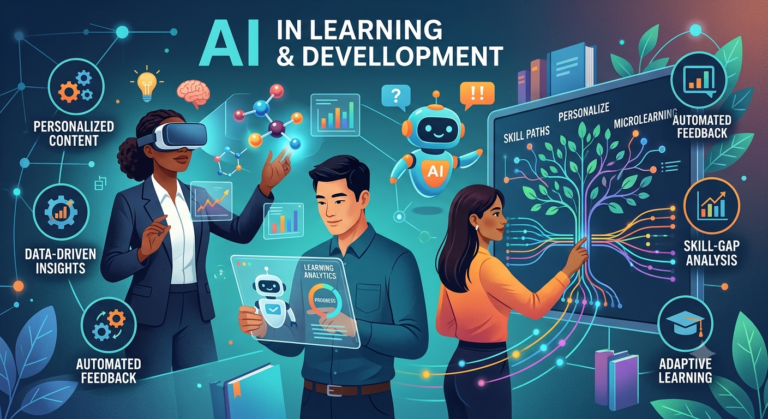
AI in learning and development (L&D) is used to analyse skills gaps, create and translate content faster, personalise learning paths, provide practice and coaching in the flow of work, and measure impact. Most L&D teams now use AI, but mainly to produce training faster. The bigger opportunity is using AI to improve performance, and leading the organisation-wide job of building AI skills.
L&D using AI
71% exploring or using
Scaling it
Only about 15%
Top use today
Faster content
Real prize
Better performance
L&D leaders are under pressure from two directions at once. AI is changing how training is designed and delivered, and AI is changing the skills the whole organisation needs. Most of the conversation focuses on the first: faster course creation, AI-generated video, chatbots that answer learners’ questions. The second is the larger opportunity, and the one boards and CEOs will increasingly hold L&D accountable for.
This guide covers both. It sets out where L&D teams actually are with AI, the use cases that matter, the best AI tools for L&D professionals, the risks to manage, whether AI will replace L&D roles, and how to measure impact beyond speed.
What Is AI in Learning and Development?
AI in learning and development is the use of artificial intelligence, including generative AI, machine learning and AI agents, across the learning cycle: identifying what people need to learn, creating and adapting learning content, delivering personalised learning and practice, supporting people while they work, and measuring whether learning changed performance.
It is useful to separate two kinds of value. AI for L&D efficiency helps the L&D team produce, translate and administer learning faster and more cheaply. AI for learning effectiveness helps employees build skills faster and perform better, through personalisation, practice, feedback and support in the flow of work. Most teams start with the first. The second is where the business case lives.
How Far Have L&D Teams Got With AI?
Adoption is broad but shallow. LinkedIn’s 2025 Workplace Learning Report, based on a survey of 937 L&D and HR professionals, found that 71% are exploring, experimenting with or integrating AI into their work. A 2026 survey of 421 L&D professionals by Synthesia, an AI video vendor, found 57% actively using AI and another 30% running early pilots. But only 9% were scaling AI across the organisation, and 6% described it as fully integrated.
Most L&D teams are still experimenting
Stage of AI adoption reported by L&D teams
Early experimentation or pilots
36%
Using AI in specific workflows
39%
Scaling across the organisation
9%
Fully integrated
6%
Source: Synthesia, AI in Learning & Development Report 2026 (421 L&D professionals, Oct–Nov 2025). Synthesia is an AI video vendor. Remaining respondents not using AI.
Practitioner sentiment reflects the same pattern. Donald H Taylor’s L&D Global Sentiment Survey 2026, with more than 3,500 voters in 105 countries, concluded that interest in AI has peaked, that organisations are now using it selectively, and that AI is adding to L&D’s stress rather than easing it.

How Can AI Be Used in L&D? Eight Use Cases
The use cases below cover the full learning cycle. For each, the human role matters as much as the AI’s.
| Use case | What AI does | What L&D and managers still own |
|---|---|---|
| 1. Skills mapping and needs analysis | Analyses role profiles, performance data and learning history to surface skills gaps | Deciding which gaps matter for the business strategy |
| 2. Content creation | Drafts outlines, scripts, quizzes, case studies and video from source material | Accuracy, instructional design and relevance |
| 3. Translation and localisation | Translates and adapts content and voiceovers into multiple languages | Cultural fit and terminology review |
| 4. Personalised learning paths | Recommends content based on role, goals, gaps and progress | Career conversations and stretch assignments |
| 5. Practice and role-play | Simulates customers, difficult conversations or presentations and gives feedback | Coaching on what the feedback means |
| 6. Support in the flow of work | Answers questions from policies and knowledge bases at the moment of need | Keeping the knowledge base accurate |
| 7. Assessment | Generates questions, scores open answers and identifies weak areas | Fairness, validity and high-stakes decisions |
| 8. Measurement and analytics | Connects learning data with performance and business data | Choosing the measures that matter and acting on them |
In practice, most current use sits at the production end. In Synthesia’s survey, the most common AI uses were quiz generation (60%), video creation (52%), AI search and knowledge assistants (40%) and translation or localisation (38%). 88% said they valued the time saved on content creation.
L&D’s AI use is concentrated on producing content
Share of L&D teams using AI for each task
Quiz generation
60%
Video creation
52%
AI search and knowledge assistants
40%
Translation and localisation
38%
Source: Synthesia, AI in Learning & Development Report 2026. Selected uses; vendor survey.
Personalisation, the use most often promised, is still largely ahead of us: only 24% of respondents saw value from AI-driven personalisation today, while 72% expected it within two years.
Producing more training faster is not the goal. If AI only helps L&D make more courses, it has automated the least valuable part of the job.
How Can HR Leaders Use AI to Personalise Learning?
Personalisation is where AI can move L&D from one-size-fits-all programmes to development that fits each person’s role, goals and gaps. Four practical approaches stand out:
- Intelligent skills mapping. AI builds a skills inventory from role profiles, performance data and learning history, then shows where gaps sit relative to the business strategy, rather than training for its own sake.
- Personalised pathways. Learning paths adjust to each person’s role and progress. For example (illustrative), a sales manager might receive negotiation practice and AI-assisted account planning, while an HR team lead receives modules on AI in recruitment and data-informed decisions.
- Practice and coaching on demand. AI role-play lets people rehearse a difficult conversation or a client presentation and get feedback, with managers coaching on what the feedback means.
- Forward-looking skills planning. Combining business plans with skills data helps HR anticipate which capabilities teams will need over the next year or two, and where internal candidates could be developed rather than hired.
Each depends on good data and on people. Personalisation fails when skills data is patchy, when employees do not trust how their data is used, or when managers are not involved in development conversations.
L&D's Bigger Job: Building AI Skills Across the Organisation
The most important question for L&D is not how to use AI in training. It is how to prepare the whole workforce to work with AI. The Microsoft and LinkedIn Work Trend Index found that 75% of knowledge workers use AI at work, yet only 39% of users had received AI training from their company. The World Economic Forum estimates that 59 in every 100 workers will need training by 2030, and LinkedIn found 49% of L&D and talent professionals report that executives are concerned employees lack the skills to execute the business strategy.
McKinsey’s March 2026 guidance on reimagining L&D for the AI age argues that “development will no longer be adjacent to work but rather a core part of work itself”, and sets out six shifts:
- Align business, talent and technology leaders around the skills that drive enterprise value.
- Build AI fluency and human-AI collaboration into leadership development.
- Use AI to deliver personalised, in-workflow learning at scale.
- Replace periodic training with continuous skilling tied to business change.
- Measure L&D with the same rigour as financial and operational performance.
- Redesign mobility and early-career pathways for a skill-driven future.
In practice, the most effective AI capability programmes are tiered: leaders first, so the direction and guardrails are clear; then managers, who drive adoption in their teams; then role-specific skills for everyone else. See our guides to AI literacy training and the benefits of AI workshops for how to structure this.

Will L&D Be Replaced by AI?
Parts of L&D work will be. Producing first drafts of content, quizzes, translations and voiceovers is already being automated, and Donald H Taylor’s 2026 survey records anecdotal reports of L&D redundancies at all levels. Teams whose value lies mainly in producing courses are exposed.
But the judgement-heavy parts of the role are becoming more important, not less: diagnosing what the business actually needs, designing experiences that change behaviour, coaching managers, building a learning culture and proving impact. LinkedIn found 91% of L&D professionals say human skills are more valuable than ever.
Our view: AI will not replace L&D, but it will replace the L&D operating model built around content production. The function that thrives will act less like a course factory and more like a performance consultant to the business, with AI doing the production work.
What Are the Best AI Tools for L&D Professionals?
There is no single best tool. Most L&D teams combine a general AI assistant with a few specialist tools. The examples below are for orientation, not endorsements; capabilities change quickly, so check each vendor directly.
| Type of tool | Typical examples | Best for |
|---|---|---|
| General AI assistants | ChatGPT, Microsoft Copilot, Claude, Gemini | Needs analysis, outlines, scripts, case studies, quizzes, summarising research |
| AI video and voice | Synthesia, HeyGen, AI voice tools | Explainer videos, voiceovers and localisation at scale |
| AI-enabled authoring tools | AI features in e-learning authoring platforms | Turning source material into interactive modules faster |
| Learning platforms (LMS / LXP) | Degreed, Docebo, Cornerstone, LinkedIn Learning | Skills data, recommendations and personalised paths |
| Practice and coaching tools | AI role-play and conversation simulators | Sales, leadership and customer-conversation practice with feedback |
Before adding tools, check what your existing platforms and your organisation’s approved AI assistant already do. Many teams find their LMS and enterprise AI licence already cover more than they use.
What Are the Risks of AI in L&D?
L&D teams in Synthesia’s survey named security (58%), accuracy (52%), lack of internal expertise (46%) and legal restrictions (41%) as their main barriers. Each can be managed.
| Risk | What it looks like | Guardrail |
|---|---|---|
| Inaccurate content | AI-generated material that sounds right but is wrong or outdated | Subject-matter review before anything is published |
| Data privacy | Employee or company data entered into unapproved tools | Approved tools only, with clear data rules |
| Bias in recommendations | Some groups steered to fewer or lower-level development opportunities | Regular review of who gets recommended what |
| Content overload | More courses that nobody needs | Start from performance problems, not content volume |
| Skills gap in L&D itself | Teams lack the AI fluency to use tools well | Train the L&D and HR team first |
For the governance side, see our Responsible AI & AI Governance training.
How to Bring AI Into Your L&D Strategy: Six Steps
- Start from business goals. Pick two or three performance problems the business cares about, such as time to productivity for new hires or sales conversion, rather than starting from a tool.
- Audit your current workflow. Find where your team spends time on manual production, curation and reporting, and where learners struggle.
- Build AI fluency in the L&D and HR team. The team needs to use AI confidently before it can redesign learning around it.
- Pilot in one area. Run a three-to-six-month pilot with one audience, using tools that integrate with your existing platforms, against a clear baseline.
- Involve managers. Managers turn learning into changed behaviour. Equip them to use learning data in coaching conversations.
- Measure, then scale. Scale what improved performance, not just what saved production time.
How Do You Measure the Impact of AI in L&D?
Most teams can show that AI made them faster. Far fewer can show that it made learners better. In Synthesia’s survey, 63% said they needed support assessing impact beyond speed. A practical scorecard covers four levels:
| Level | Example measures |
|---|---|
| Efficiency | Time and cost to produce, translate and update content |
| Learning | Engagement, completion, assessed skill improvement |
| Behaviour | Manager-observed change, use of new skills on the job |
| Business | Time to productivity, quality, sales, retention, internal mobility |
For a wider framework, see our guide to how to measure AI ROI.
How 10X AI Leaders Helps HR and L&D Teams
We run instructor-led, hands-on AI workshops for HR and L&D teams, and help them design AI capability programmes for the wider organisation. Workshops are built around your team’s real work: needs analysis, programme design, content, personalisation, measurement and governance. We recommend in-person workshops for the strongest engagement, delivered face to face at your organisation, with live online sessions available for distributed international teams.
Every use case is tested through our 10X Humane AI Lens: is the value real, is this the right use of AI, does it raise people up, and who remains responsible? Explore our corporate AI training and workshops or our AI change management workshop for HR and people leaders.
Frequently Asked Questions About AI in Learning and Development
What is AI for learning and development?
AI for learning and development is the use of AI, including generative AI, to analyse skills needs, create and translate learning content, personalise learning paths, support people in the flow of work and measure the impact of learning on performance.
How can AI be used in L&D?
The main uses are skills mapping and needs analysis, content creation, translation and localisation, personalised learning paths, practice and role-play with feedback, support in the flow of work, assessment, and learning analytics. Today most teams use AI mainly for content production.
Will L&D be replaced by AI?
AI will automate much of L&D’s content production, so roles focused mainly on producing courses are at risk. The judgement-heavy work of diagnosing business needs, designing for behaviour change, coaching managers and proving impact is becoming more important. AI is more likely to change the L&D operating model than to replace the function.
What are the best AI tools for L&D professionals?
Most L&D teams combine a general AI assistant such as ChatGPT, Microsoft Copilot, Claude or Gemini with specialist tools: AI video and voice tools such as Synthesia, AI features in authoring tools, learning platforms such as Degreed, Docebo or Cornerstone, and AI role-play simulators for practice.
Which AI is best for learning and teaching?
For designing learning, general AI assistants such as ChatGPT, Claude, Gemini and Microsoft Copilot are the most versatile. For delivering learning, the best choice depends on the need: AI tutors and assistants for questions, simulators for practice, and learning platforms for personalised paths. The best AI is usually the one your organisation has approved and integrated.
Can AI transform your L&D strategy?
Yes, if it is used to improve performance rather than just produce content faster. AI makes continuous, personalised, in-workflow learning practical at scale, and McKinsey argues L&D should shift from periodic training to continuous skilling tied to business change.
Is AI-generated learning content reliable?
Not without review. AI can produce plausible but inaccurate or outdated material, which is why accuracy is one of the top concerns for L&D teams. Treat AI output as a first draft for subject-matter experts and instructional designers to check.
What is generative AI in learning and development?
Generative AI in L&D refers to AI that creates content, such as text, quizzes, scenarios, images, video and voice, and that powers conversational tutors and role-play simulators. It is the main driver of the recent surge in AI adoption by L&D teams.
What are the 7 stages of AI development?
There is no official seven-stage model. Popular online frameworks describe a progression from rule-based systems through context-aware, domain-specific and reasoning systems to artificial general intelligence, superintelligence and a hypothetical singularity; only the early stages exist today. For L&D teams, a more useful sequence is adoption maturity: experimenting, piloting, using AI in specific workflows, scaling, and full integration.
Are there AI in learning and development courses or certifications?
Yes. Professional bodies such as ATD, online platforms such as Coursera and LinkedIn Learning, and independent practitioners offer AI courses and certificates for L&D professionals. For an in-house L&D or HR team, a tailored workshop built around your own programmes and tools often delivers faster practical results.
Do HR and L&D teams need technical skills to use AI?
No. HR and L&D teams need AI fluency: understanding what AI can and cannot do, using approved tools well, checking outputs, and knowing the data and ethical guardrails. Coding is not required.
References
- LinkedIn Learning, 2025 Workplace Learning Report
- Synthesia, AI in Learning & Development Report 2026
- Donald H Taylor, L&D Global Sentiment Survey 2026 (February 2026)
- McKinsey, Reimagine Learning and Development for the AI Age (March 2026)
- Microsoft & LinkedIn, 2024 Work Trend Index (May 2024)
- World Economic Forum, The Future of Jobs Report 2025 (January 2025)
Ready to build AI capability in your leadership team?Instructor-led, hands-on AI workshops for leaders and managers
Explore AI Training →
About the author
Anupma Singh
Founder & AI Strategy Advisor, 10X AI Leaders · IIT Kanpur
Anupma Singh is the Founder and AI Strategy Advisor of 10X AI Leaders and an IIT Kanpur alumna. She has 25 years of experience across technology, business transformation and AI adoption strategy, including leadership roles at Infosys and Honeywell. She has trained 100+ business leaders and runs instructor-led AI workshops that help leadership teams move from AI-curious to AI-confident.