
Quick Answer
How Is AI Changing Leadership?
AI is taking over much of the information work leaders used to do, such as analysis, reporting and first drafts, and shifting the leadership role towards judgement, setting direction, building trust and redesigning how work gets done. Leadership in the age of AI is not less human; it is more human, but it now requires AI literacy. Research links leaders' understanding of AI to readiness, adoption and financial performance.
What AI takes
Analysis, drafts, reporting
What stays human
Judgement, aspiration, trust
New requirement
AI literacy
Biggest gap
Redesigning work around AI
Every major technology shift has changed what leaders do. Electricity changed factories, computers changed offices, the internet changed markets. AI is different in one important way: it does not only change the work leaders oversee, it changes the work of leading itself. It can analyse, draft, summarise and recommend, which are exactly the activities that once filled a leader’s week.
That raises uncomfortable questions. If AI can do the analysis, what is the leader for? Which leadership skills still matter, and which new ones are needed? And how far behind are most leadership teams? This guide answers those questions with research from Gartner, McKinsey, Gallup, BCG, the World Economic Forum and others, and closes with a practical 90-day plan.
How Is AI Affecting Leadership? What the Research Shows
Leaders broadly agree that AI will reshape their organisations. Far fewer believe they are ready. In research by Egon Zehnder and Kearney, 70% of business leaders expected their company to be disrupted by AI within five years, but only one in five believed their organisation was prepared. More than half (51%) said a lack of understanding of AI among leaders was part of the problem.
Leaders see the disruption, but few feel ready
Business leaders surveyed by Egon Zehnder and Kearney
Expect their company to be disrupted by AI within five years
Cite a lack of AI understanding among leaders
Believe their organisation is prepared
Tellingly, among the leaders who did feel prepared, 89% credited their leadership team’s understanding of AI. Readiness, in other words, starts at the top.
CEOs see the same gap in their own teams. In a Gartner survey of 456 CEOs and senior executives, 77% said AI is ushering in a new business era, yet CEOs judged only 44% of their CIOs to be “AI-savvy”, and saw similar gaps across the rest of the executive team.
Senior leaders are, however, the heaviest users of AI. Gallup’s late-2025 survey of more than 22,000 US workers found that 69% of leaders used AI at work, and 44% used it frequently, compared with 40% and 23% of individual contributors. The problem is not that leaders are avoiding AI. It is that personal use has not yet become organisational change. A General Assembly survey of 651 US and UK leaders (General Assembly is itself a training provider) found that 62% had attended AI training, but only 38% had restructured their team’s workflows around AI.
1 in 5
leaders believe their organisation is prepared for AI disruption
44%
of CIOs are seen as “AI-savvy” by their CEOs
69%
of US leaders use AI at work, more than any other group
38%
of leaders have redesigned team workflows around AI
Will Leadership Be Replaced by AI?
No, and the reason is structural rather than sentimental. AI can recommend; it cannot be accountable. In January 2026, McKinsey’s global managing partner Bob Sternfels, World Economic Forum president Børge Brende and McKinsey senior partner Daniel Pacthod argued in Building Leaders in the Age of AI that three capabilities remain uniquely human:
- Setting the right aspiration, and enrolling others to own it.
- Demonstrating judgement, by aligning choices with values when they conflict. AI is advisory, not authoritative, and bears no responsibility for its outputs.
- Designing for non-linear outcomes: setting an audacious brief, inviting dissent and holding the line through messy early iterations.
Their summary is worth quoting: effective leaders “will use AI to think with them, not for them.” What AI will replace is a style of leadership built on controlling information, approving routine decisions and producing reports. Leaders whose value lay there will find their role shrinking. Leaders whose value lies in judgement and people will find their role growing.
For a deeper look at what this means for the management layer, see our analysis: Can AI replace managers?
AI does not make leadership less important. It removes the work that used to disguise weak leadership, and exposes the judgement, direction and trust that were always the real job.
Five Shifts: What Leadership in the Age of AI Looks Like
Across the research and our work with leadership teams, five shifts stand out.
| From | To |
|---|---|
| Command and control: leaders direct and approve | Context and guardrails: leaders set purpose, values and decision rights, then let people and AI act within them |
| The expert with the answers | The learner with the right questions, comfortable using and challenging AI in front of the team |
| Information gatekeeper | Meaning-maker: when everyone has the analysis, the leader’s job is to decide what it means and what to do |
| Managing people | Orchestrating people and AI: designing how human and AI capacity combine in each workflow |
| Annual plans | Continuous experimentation: small bets, fast learning and the discipline to stop what does not work |
AI Leadership Skills: The Seven That Matter Most
Lists of “AI leadership skills” are everywhere, and most are opinion. Below are the seven skills we see making the biggest difference, each grounded in published research. Five are human skills that matter more because of AI; two are new.
1. AI literacy
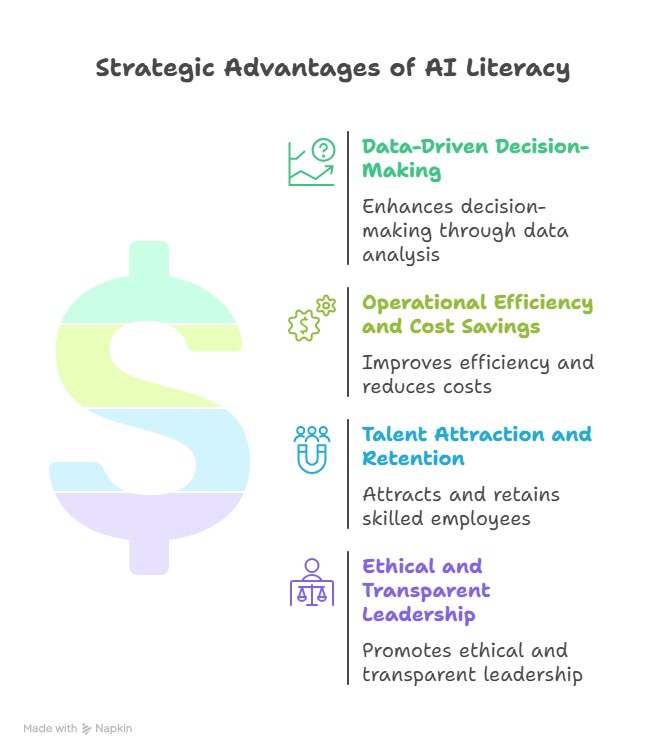
Leaders need to know what AI can and cannot do, how to use it on their own work, and how to judge its output, without becoming technologists. The business case is direct: Gartner predicts that by 2027, organisations that emphasise AI literacy for executives will achieve 20% higher financial performance than those that do not. Gartner recommends experiential learning, making AI tangible through hands-on use, rather than theory. AI-literate leaders also make better procurement decisions, manage vendor risk and set realistic expectations for what AI projects will deliver.
How to build it: use AI daily on your own work, join a hands-on leadership AI workshop rather than a video course, and spend time with your data and technology teams turning AI potential into business outcomes.
2. Judgement under abundance
When analysis is cheap and plentiful, the scarce resource is good judgement: deciding which questions matter, weighing trade-offs AI cannot see, and knowing when to overrule the model. McKinsey places judgement at the centre of what remains uniquely human, and Zenger Folkman’s 2026 research on more than 15,000 leaders found that the top 10% of decision-makers dramatically outperform their peers on overall effectiveness and team engagement. In practice, the best leaders combine experience with data: they read AI dashboards and forecasts critically, ask what the data cannot see, and then decide.
How to build it: before major decisions, ask AI to argue the opposite case and list what could go wrong; then write down what you decided and why, and review it later.
3. Inspiring and setting direction
As AI takes over routine execution, the ability to give work meaning becomes more valuable. It is also where most leaders are weakest. Zenger Folkman’s research found that 76% of leaders are rated stronger at driving for results, while only 22% are rated stronger at inspiring and motivating others.
How to build it: use the time AI saves you to explain the why behind priorities, connect each person’s work to customers and strategy, and recognise effort publicly.
Leaders are stronger at pushing than inspiring
Share of leaders rated stronger in each skill
Driving for results
Inspiring and motivating others
4. Building trust and psychological safety
AI adoption asks people to experiment, admit what they do not know and change how they work, all while worrying about their jobs. That only happens where people feel safe. Zenger Folkman found that in teams whose leaders foster psychological safety, intent to quit fell from 37% to 20% and the share giving extra effort rose from 23% to 47%. BCG found the same pattern for AI specifically: the share of employees who feel positive about generative AI rises from 15% to 55% with strong leadership support.
Empathy also changes shape. An AI tool might flag signs of burnout in a team’s working patterns, but only a leader can respond with care. The principle: use AI data to start human conversations, not to replace them.
How to build it: talk openly about what AI will and will not change in people’s roles, admit what you are still learning, and present AI as a way to remove low-value work rather than people.
What leadership support changes
Without vs with the leadership behaviour
Employees positive about GenAI (BCG)
Employees giving extra effort (Zenger Folkman)
Sources: BCG, AI at Work 2025; Zenger Folkman, Leadership Skills 2026
5. Redesigning work
This is the skill most leaders have not yet built. Using AI personally is easy; redesigning how a team works around it is hard. With only 38% of leaders having restructured workflows around AI in the General Assembly survey, the gap between individual productivity and organisational value is largely a work-design gap. Because AI initiatives cut across IT, HR, operations and the business, this skill is also about collaboration: translating technical potential into business value and creating shared ownership across functions.
How to build it: pick one workflow with your team, map it step by step, decide what AI should automate, augment or leave alone, and involve both business and technical colleagues in the redesign.
6. Learning agility
The World Economic Forum expects 39% of workers’ core skills to change by 2030. Leaders cannot ask their organisations to keep relearning unless they do it visibly themselves. The WEF also found that leadership and social influence gained more ground as a core skill than any other since 2023, rising 22 percentage points.
How to build it: run short, regular AI learning sprints with your team, share what works in an internal community, and recognise people who teach others.
7. Responsible AI stewardship
Leaders are accountable for how AI is used in their part of the business: what data goes in, which decisions it influences and who checks the output. That requires enough understanding to set guardrails and the confidence to say no. We use the 10X Humane AI Lens for this: is the value real, is this the right use of AI, does it raise people, and who remains responsible? A finance leader, for example, should be able to ask whether a credit-scoring model is transparent, regularly audited for bias, and overseen by a human.
How to build it: agree a clear AI usage policy for your area, involve diverse perspectives in AI decisions to reduce blind spots, and build basic AI governance knowledge through training.
What are the 5 critical skills leaders need in the age of AI?
Writing in Harvard Business Review in October 2025, Herminia Ibarra and Michael G. Jacobides identified five critical skills for leaders in the age of AI, arguing that success depends less on the technology than on leadership and organisational transformation:
- Building networks across organisational boundaries to bring in diverse perspectives on AI.
- Redesigning workflows and structures so AI is integrated in meaningful ways.
- Orchestrating collaboration and decision-making between people and AI.
- Coaching and developing people, with psychological safety, to work alongside AI.
- Modelling AI use personally, leading by example.
Their list overlaps closely with the seven above, particularly on redesigning work, building trust and leading by example. The common thread is that AI leadership is learned by doing, not by reading.
What Makes an AI-Literate Leader?
An AI-literate leader is not a technologist. They are a business leader who understands AI well enough to make sound decisions about it. In practice, they can:
- Explain in plain language what AI can and cannot do in their industry.
- Use AI regularly on their own work, and know when its output is wrong.
- Spot where AI could change decisions and workflows in their area, and prioritise the few that matter.
- Ask vendors and internal teams the right questions about value, data, cost and risk.
- Set guardrails and stay accountable for decisions AI influences.
- Lead their people through the change honestly.
The evidence that this matters keeps accumulating: Gartner’s 20% performance prediction, Egon Zehnder’s finding that 89% of prepared leaders credit their team’s AI understanding, and the AI-literacy requirements now appearing in regulation such as Article 4 of the EU AI Act. To build these capabilities across a leadership team, see our AI literacy training for executives.
How Can AI Be Used in Leadership?
The most effective leaders use AI as a thinking partner, not an autopilot. These are practical uses we see working, with the part that must stay human.
| Use | How AI helps | What stays human |
|---|---|---|
| Decision preparation | Summarises evidence, lists options, stress-tests assumptions | The decision and the accountability |
| Scenario planning | Models scenarios and second-order effects quickly | Choosing which future to prepare for |
| Communication | Drafts messages and anticipates how audiences may react | The message, the tone and the conversation |
| Coaching preparation | Helps structure feedback and plan development conversations | The relationship and the honesty |
| Learning | Explains unfamiliar topics, markets and technologies on demand | Judging what is credible and relevant |
| Sensing the organisation | Surfaces themes from surveys, feedback and customer data | Listening directly and acting on what matters |
How Organisations Use AI in Leadership Development
AI is not only changing what leaders do; it is changing how organisations develop them. Large employers, including many in India and across Asia, are moving leadership development from one-off classroom programmes towards continuous, AI-supported systems. Five uses are becoming common.
| Use | What it involves | Watch out for |
|---|---|---|
| Assessment and succession | Mapping skills and leadership readiness across large populations to target development | Bias in models; decisions must stay with people |
| Personalised learning | Adaptive learning paths, simulations of crises and ethical dilemmas, and nudges to apply skills on the job | Content without practice does not change behaviour |
| AI-supported coaching | Feedback on communication style and micro-coaching between human coaching sessions | Privacy and trust if people feel monitored |
| Decision analytics | Dashboards and models that help leaders forecast, find inefficiencies and test options | Data quality; over-reliance on outputs |
| Team and culture insight | AI assistants for follow-ups and HR platforms that surface engagement and burnout signals | Surveillance concerns; insight must lead to human action |
The obstacles are consistent too: managers who lack confidence with AI tools, employees who fear bias or surveillance, poor data quality, and leaders who still see AI as “tech for the tech team”. The answer in every case is practical, non-technical capability-building for leaders, combined with clear guardrails.
Leadership in the Age of AI in India and Asia
For leaders in India, Malaysia, Singapore and across Asia, the leadership challenge arrives faster. Microsoft and LinkedIn’s 2024 Work Trend Index found AI use at work of 92% in India, 88% in Singapore and 84% in Malaysia, against 75% globally. Yet 54% of Indian leaders and 68% of Singaporean leaders worried that their organisation lacked a plan and vision for implementing AI.
People are moving faster than plans
Microsoft & LinkedIn Work Trend Index, 2024
Knowledge workers using AI at work
Leaders worried their organisation lacks an AI plan and vision
Sources: Microsoft & LinkedIn 2024 Work Trend Index country releases (India, Singapore, Malaysia).
In many organisations across the region, from conglomerates and family-owned groups to banks, government-linked companies and India’s global capability centres, employees are already using AI faster than leadership has set direction. That makes the leadership shifts above more urgent: setting a clear aspiration, agreeing guardrails, and turning scattered individual use into redesigned, shared ways of working.
How to Succeed in the Age of AI: A 90-Day Plan for Leaders
Leadership capability is built through practice, not reading. This is the sequence we recommend to leaders who want to move from AI-curious to AI-confident.
Days 1–30
Use it yourself
Use an approved AI tool daily on real work: preparing decisions, analysing reports, drafting communications. Note where it helps and where it fails.
Days 31–60
Choose where it matters
With your team, identify the few decisions and workflows where AI could create real value. Prioritise two or three, with owners and measures.
Days 61–90
Redesign and lead
Redesign one workflow, agree guardrails, talk openly with your team about what changes, and review results together.
For help choosing priorities, see our guide to AI use case prioritization; for leading the people side, our AI change management workshop.
FAQs
Will leadership be replaced by AI?
No. AI can analyse, draft and recommend, but it cannot set aspirations, make value-based judgements or be accountable for outcomes. McKinsey argues these remain uniquely human. What AI will replace is leadership built mainly on controlling information and producing reports.
How is AI affecting leadership?
AI is shifting leaders’ time away from analysis and reporting towards judgement, direction-setting, trust-building and redesigning work. It also raises the bar: Egon Zehnder and Kearney found only one in five leaders feel their organisation is prepared for AI disruption, and 51% cite leaders’ lack of AI understanding.
What are AI leadership skills?
AI leadership skills combine new capabilities, such as AI literacy and redesigning work around AI, with human skills that matter more because of AI: judgement, inspiring and setting direction, building trust and psychological safety, learning agility and responsible AI stewardship.
What are the 5 critical skills leaders need in the age of AI?
In Harvard Business Review (October 2025), Herminia Ibarra and Michael G. Jacobides named five: building networks across organisational boundaries, redesigning workflows around AI, orchestrating collaboration between people and AI, coaching people to work alongside AI, and modelling AI use personally. Our own list adds AI literacy, judgement and responsible AI stewardship.
How are organisations using AI in leadership development?
Common uses include AI-supported assessment and succession planning, personalised learning paths and simulations, AI coaching assistants, decision analytics for leaders, and tools that surface team engagement signals. Each needs guardrails for bias, privacy and trust.
How can managers start using AI without technical expertise?
Start with everyday work: summarising documents, preparing meetings, drafting communications and analysing reports with an approved AI tool. Then join a hands-on, role-specific AI workshop to learn safe use and judgement, and apply AI to one team workflow.
What are the top 5 AI skills for business leaders?
For business leaders, the most useful AI skills are understanding what AI can and cannot do, using AI on their own work, judging AI output critically, identifying and prioritising AI use cases, and setting guardrails for responsible use. None requires coding.
What are the top 5 skills for leadership?
Commonly cited core leadership skills include decision-making, communication, inspiring and motivating others, building trust, and developing people. Research by Zenger Folkman suggests inspiring and motivating is a particular gap: only 22% of leaders are rated stronger at it than at driving for results.
How can AI be used in leadership?
Leaders use AI to prepare decisions, model scenarios, draft communications, prepare coaching conversations, learn about unfamiliar topics and surface themes from feedback and data. The decision, the relationships and the accountability stay with the leader.
What is an AI-literate leader?
An AI-literate leader understands AI well enough to make sound decisions about it: what it can and cannot do, how to use it on their own work, how to judge its output, where it can create value, and how to set guardrails. It does not require technical expertise.
What is the future of leadership with AI?
The future of leadership is likely to involve smaller, flatter structures, teams that combine people and AI agents, faster decisions based on live data, and a greater emphasis on judgement, trust and purpose. Leaders who combine AI fluency with strong human skills will be best placed.
How do you succeed in the age of AI as a leader?
Start by using AI yourself on real work, then identify the few decisions and workflows where it matters most, redesign at least one with your team, agree guardrails, and lead the people side of the change openly. Keep learning visibly; capabilities change quickly.
What are the 7 C’s of leadership?
There is no single standard “7 C’s of leadership”; different authors use different lists. Common elements include clarity, communication, character, courage, compassion, collaboration and consistency. In the age of AI, clarity and character matter more, because AI can produce answers but not purpose or integrity.
Which jobs will not be replaced by AI?
No credible research gives a definitive list. The most resilient roles rely on judgement and accountability, trust and relationships, care, physical dexterity and leading people through ambiguity. Leadership roles focused on these, rather than on administration, are among the most durable.
References
- Egon Zehnder & Kearney, Leadership in the Age of AI (January 2024)
- Gartner, CEOs Believe Their Executive Teams Lack AI Savviness (May 2025)
- Gartner, Top Data & Analytics Predictions (June 2025)
- Gallup, Frequent Use of AI in the Workplace Continued to Rise in Q4 (2025)
- General Assembly, Leaders Are Gaining Ground on AI Skills, but Big Gaps Remain (September 2025)
- Sternfels, Brende and Pacthod, Building Leaders in the Age of AI, McKinsey (January 2026)
- Ibarra and Jacobides, 5 Critical Skills Leaders Need in the Age of AI, Harvard Business Review (October 2025)
- Zenger Folkman, Leadership Skills 2026 Report
- BCG, AI at Work 2025: Momentum Builds, but Gaps Remain (June 2025)
- World Economic Forum, Future of Jobs Report 2025: Skills Outlook
- Microsoft, 92% of Indian Knowledge Workers Use AI in the Workplace (May 2024)
- Microsoft, 2024 Work Trend Index: Singapore (May 2024)
- Microsoft, 2024 Work Trend Index: Malaysia (June 2024)
Recent Posts
Ready to build AI capability in your leadership team?Instructor-led, hands-on AI workshops for leaders and managers
Explore AI Training →
About the author
Anupma Singh
Founder & AI Strategy Advisor, 10X AI Leaders · IIT Kanpur
Anupma Singh is the Founder and AI Strategy Advisor of 10X AI Leaders and an IIT Kanpur alumna. She has 25 years of experience across technology, business transformation and AI adoption strategy, including leadership roles at Infosys and Honeywell. She has trained 100+ business leaders and runs instructor-led AI workshops that help leadership teams move from AI-curious to AI-confident.