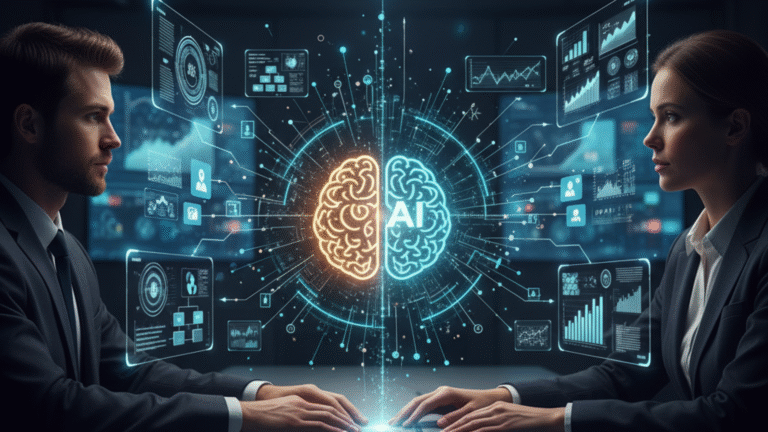
In 2026, leadership is no longer about choosing between intuition and technology — it’s about mastering both. As artificial intelligence reshapes how organizations think, decide, and operate, the most effective leaders are those who embrace Human AI Collaboration, combining human judgment with AI-driven insights to make faster, fairer, and more strategic decisions.
For HR and L&D professionals, this shift marks a defining moment. Traditional leadership development can’t keep pace with the demands of AI-assisted decision-making. That’s why AI for Leaders and AI training for managers now emphasize Human AI Collaboration — helping executives leverage the power of AI while preserving empathy, ethics, and the uniquely human touch that great leadership depends on.
Why Human Judgment Still Matters in the Age of AI
AI can process data at incredible speed, but it lacks empathy, ethics, and emotional context — qualities that define great leadership. Human judgment provides the balance between what’s possible and what’s right.
The best leaders don’t blindly follow algorithms. Instead, they interpret AI insights through the lens of human experience, culture, and values.
Example:
A global retailer used AI to predict workforce restructuring needs. Instead of implementing the AI’s recommendation immediately, leadership applied human judgment — considering morale, diversity, and team cohesion — resulting in a better long-term outcome and higher retention rates.
Takeaway: AI informs decisions; humans shape their impact.
How AI Supports, Not Replaces, Leadership Decisions
1. Data-Driven Clarity for Complex Problems
AI gives leaders a clearer picture of reality by analyzing patterns humans might overlook. Whether forecasting sales, monitoring engagement, or assessing risk, AI turns data into insights that support better decision-making.
Example: A financial services leader used AI dashboards to identify early signs of burnout among managers. By combining this data with one-on-one conversations, they implemented a wellbeing strategy before turnover rose.
Result: Human empathy guided by AI evidence.
2. Removing Bias and Strengthening Fairness
AI can help eliminate cognitive biases that often cloud human decisions — if used correctly. For instance, AI for managers in recruitment or promotion processes can identify trends and flag potential bias in human choices.
However, AI is only as fair as the data it’s trained on. This is where human oversight is essential. Leaders must question outputs, validate assumptions, and ensure AI systems align with organizational ethics.
Best practice: Pair data scientists with HR and leadership coaches to ensure AI decisions support diversity, equity, and inclusion goals.
3. Speed and Scale in Decision Execution
In fast-changing environments, waiting for complete information can lead to missed opportunities. AI enables leaders to act quickly by providing scenario-based recommendations.
Example: During market volatility, an operations leader used AI to simulate three pricing strategies. Combined with their market experience, they selected the approach that balanced customer loyalty with profitability — achieving better results than AI or human reasoning alone.
Key insight: AI accelerates execution, but leaders define direction.
4. Emotional Intelligence: The Irreplaceable Skill
No matter how advanced AI becomes, it can’t empathize, inspire, or lead through uncertainty. Great leaders use emotional intelligence to interpret AI outputs — understanding how decisions affect people, not just performance metrics.
In AI workshops, participants often realize that empathy and communication are now strategic assets, not soft skills. The more AI influences business, the more leaders must humanize their decision-making.
Pro tip: Incorporate emotional intelligence modules into AI training to balance analytical and human capabilities.
Real-World Examples of Human-AI Collaboration in Leadership
PepsiCo uses AI analytics to predict consumer trends, but final product decisions are made by cross-functional teams who add cultural and creative insights.
Microsoft blends AI models with human judgment in ethical review boards to ensure responsible AI use.
Unilever applies AI to screen candidates, then relies on human interviewers to assess cultural fit and leadership potential.
Each case shows that leadership success lies in AI collaboration, not AI delegation.
When humans and AI work best together —
and when each is better alone
-MIT Solan Research
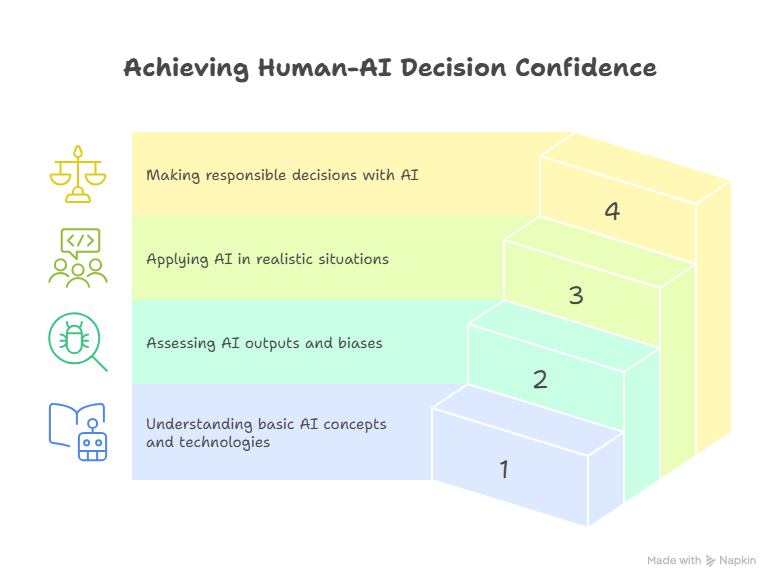
Building Human-AI Decision Confidence Through Training
To thrive in AI-augmented workplaces, leaders need structured AI training that strengthens both analytical and emotional muscles.
Here’s what forward-thinking AI workshops include:
AI literacy: Understanding how AI models generate insights.
Critical evaluation: Questioning data sources, limitations, and biases.
Scenario practice: Simulating AI-assisted decision-making.
Ethical judgment: Balancing efficiency with fairness and impact.
These programs help leaders trust AI without over-relying on it, fostering confident, balanced decisions.
The New Leadership Equation: Intelligence + Integrity
AI may amplify intelligence, but leadership still demands integrity. Great leaders understand that technology should enhance not replace human wisdom. When they practice Human AI Collaboration, combining data with empathy, algorithms with ethics, and speed with strategy, they build cultures of smart, responsible innovation.
As organizations invest in AI for leaders, the greatest opportunity lies in developing leaders who are both data-savvy and deeply human. This balance powered by Human AI Collaboration defines the next era of leadership excellence.
Conclusion
The leaders who will thrive in 2026 and beyond are those who master Human AI Collaboration, integrating artificial intelligence into their decision-making while staying grounded in human intuition and empathy.
For HR and L&D professionals, the path forward is clear: design AI training and leadership workshops that strengthen both logic and compassion. Because when human judgment meets AI precision through true Human AI Collaboration, leadership evolves from reactive to visionary.
FAQs on Human-AI Collaboration
1. Can AI replace human judgment in leadership decisions?
No. AI enhances decision-making by providing data and insights, but human judgment is essential for ethical, emotional, and contextual balance.
2. How can leaders learn to use AI effectively?
Through structured AI workshops and AI training programs that teach leaders to interpret AI outputs, evaluate risks, and make informed, human-centered choices.
3. What’s the risk of relying too much on AI?
Over-reliance can lead to bias, loss of creativity, and missed nuances. Leaders should treat AI as a co-pilot, not an autopilot.
4. What soft skills remain critical in an AI-driven world?
Emotional intelligence, communication, ethical reasoning, and adaptability remain the foundation of great leadership.
5. Why is AI for managers important?
It equips managers with analytical tools to make better decisions, drive performance, and lead teams confidently in data-rich environments.