
As artificial intelligence becomes a cornerstone of modern business, the pressure on leaders to use it responsibly has never been higher. From hiring algorithms to performance analytics, AI is now woven into daily management decisions. But with great power comes great responsibility, and ethical AI is no longer just a technical issue; it’s a leadership one.
In 2027, modern managers must understand not only how AI works but also how to ensure it aligns with fairness, transparency, and accountability. This is where AI for leaders, AI training, and hands-on AI workshops play a critical role in helping organizations stay both competitive and compliant.
This guide breaks down what every manager needs to know about ethical AI and how to lead with integrity in an AI-powered world.
With its unique mandate, UNESCO has led the international effort to ensure that science and technology develop with strong ethical guardrails for decades.
Why Ethical AI Matters in Leadership Today
AI systems influence everything from who gets hired to which products customers see first. When used correctly, they can improve efficiency and eliminate bias. When used carelessly, they can amplify inequities, violate privacy, and damage trust.
For example, several companies have faced backlash due to biased hiring algorithms that favored certain demographics. These incidents remind us that even unintentional bias in AI can harm people and reputations alike.
Ethical leadership means ensuring that AI decisions reflect human values — not just data outputs. Modern managers are expected to understand AI’s implications and apply ethical reasoning to every decision that involves it.
Core Principles of Ethical AI for Managers
1. Transparency and Explainability
Leaders should be able to explain how and why an AI system made a decision. Black-box algorithms erode trust, especially in HR and performance management contexts.
Action step: Require all AI tools used in your organization to include explainability features or audit reports that clarify data sources and decision logic.
2. Fairness and Bias Prevention
AI systems can unintentionally perpetuate discrimination if they learn from biased data. Ethical managers take steps to detect, test, and correct bias regularly.
Example: An HR manager using AI for promotions should cross-check model outputs for patterns that disadvantage any demographic group.
Pro tip: Include AI training modules that teach managers to identify and mitigate algorithmic bias in day-to-day operations.
3. Accountability and Oversight
Even when AI assists decision-making, the responsibility still lies with the human leader. Managers can’t delegate ethical accountability to a machine.
Best practice: Establish an internal AI ethics board or cross-functional review team that evaluates all major AI use cases before deployment.
This ensures both compliance and alignment with company values.
4. Privacy and Data Protection
AI thrives on data — but collecting and using it responsibly is a leadership mandate. Managers must ensure employees’ and customers’ data is used transparently and with consent.
Tip: Implement privacy-by-design practices in all AI initiatives. During AI workshops, discuss real-life scenarios that test how leaders handle sensitive data ethically.
5. Human Oversight and Judgment
AI provides recommendations, not orders. Great leaders balance machine insights with human context. This hybrid approach — AI for managers plus human reasoning — ensures decisions remain empathetic and balanced.
Example: A logistics manager may rely on AI to optimize scheduling but still factor in employee wellbeing and unforeseen circumstances before finalizing decisions.
Building Ethical AI Competence Through Training
To manage AI ethically, leaders need more than awareness — they need skills. Progressive organizations are integrating AI training and AI for leaders programs to help executives and managers build this competence.
These programs typically cover:
Ethical frameworks: Understanding fairness, accountability, and transparency in AI systems.
Case-based learning: Analyzing real ethical dilemmas in AI use.
AI literacy: Knowing how algorithms work and how to question their outputs.
Decision-making practice: Using simulations to apply ethics in real-world scenarios.
Outcome: Managers gain confidence to make responsible AI decisions, preventing ethical risks before they escalate.
Integrating Ethical AI Into Leadership Culture
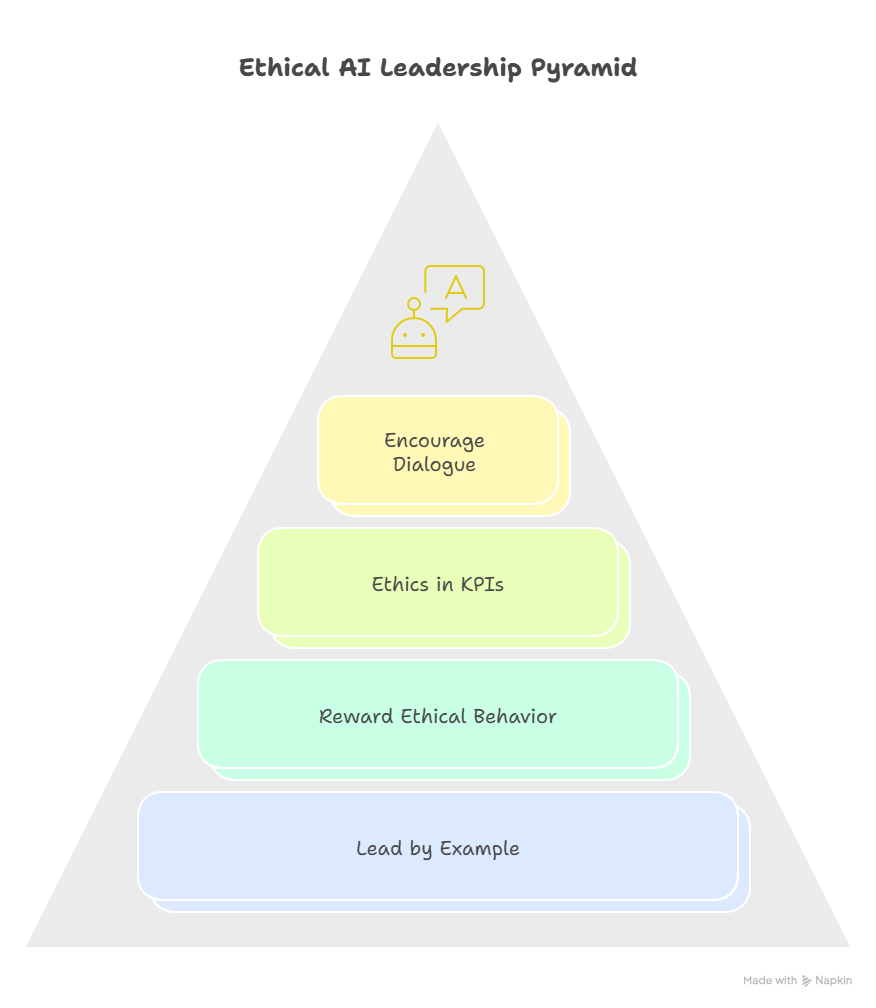
Ethical AI isn’t a one-time initiative — it’s a culture shift. Leaders must model ethical thinking in every interaction with technology.
Here’s how to embed it across teams:
Lead by example: Show employees how you evaluate AI recommendations critically.
Reward ethical behavior: Recognize managers who raise ethical concerns early.
Include ethics in KPIs: Track not just results, but how ethically those results were achieved.
Encourage open dialogue: Create safe spaces to discuss AI ethics concerns without fear of backlash.
Remember: When leaders make ethics visible, it becomes part of organizational DNA.
Real-World Example: Ethical AI in Action
A global bank introduced AI-driven credit-scoring tools but discovered early discrepancies in approval rates across demographic groups. Instead of hiding the problem, the leadership team conducted an ethics audit, adjusted the algorithms, and launched an internal AI training initiative for all senior managers.
The result? Enhanced trust, stronger compliance, and a reputation for ethical leadership in technology use
The Future of Ethical Leadership in the AI Era
As AI continues to shape the workplace, ethical competence will define successful leadership. Future-ready managers will be those who combine data literacy, ethical reasoning, and human judgment to guide their teams responsibly.
In the coming years, organizations that invest in AI workshops and AI for leaders programs focused on ethics will not only avoid risk, they’ll gain a competitive edge built on trust and transparency.
Conclusion
Ethical AI isn’t about limiting innovation; it’s about guiding it with integrity. For modern managers, this means blending human values with technological intelligence to create workplaces that are both high-performing and humane.
If your organization hasn’t yet started integrating ethical AI into leadership development, now is the time. Begin with tailored AI training or leadership-focused AI workshops to build the foundation for responsible, future-ready management.
Because in the end, it’s not just about what AI can do — it’s about what leaders choose to do with it.
FAQs
1. What is ethical AI in management?
Ethical AI ensures that AI systems are transparent, fair, and accountable. Managers use these principles to guide responsible technology use in decision-making.
2. Why should managers learn ethical AI?
Understanding ethical AI helps managers avoid bias, maintain trust, and ensure compliance with laws and values while using AI in daily operations.
3. Can AI training include ethics modules?
Yes. All AI Trainings by 10X AI Leaders include ethical frameworks, bias detection, and case-based learning for leaders.
4. How can HR support ethical AI use?
HR can integrate ethics checkpoints in AI tools, monitor fairness in recruitment or performance analytics, and provide AI for leaders’ programs.
5. What happens when AI makes unethical recommendations?
Leaders must override AI outputs that conflict with ethical or organizational principles — human oversight remains non-negotiable.
Recent Posts
Ready to build AI capability in your leadership team?Instructor-led, hands-on AI workshops for leaders and managers
Explore AI Training →
About the author
Anupma Singh
Founder & AI Strategy Advisor, 10X AI Leaders · IIT Kanpur
Anupma Singh is the Founder and AI Strategy Advisor of 10X AI Leaders and an IIT Kanpur alumna. She has 25 years of experience across technology, business transformation and AI adoption strategy, including leadership roles at Infosys and Honeywell. She has trained 100+ business leaders and runs instructor-led AI workshops that help leadership teams move from AI-curious to AI-confident.